Description
Numéro consultable en ligne sur Cairn
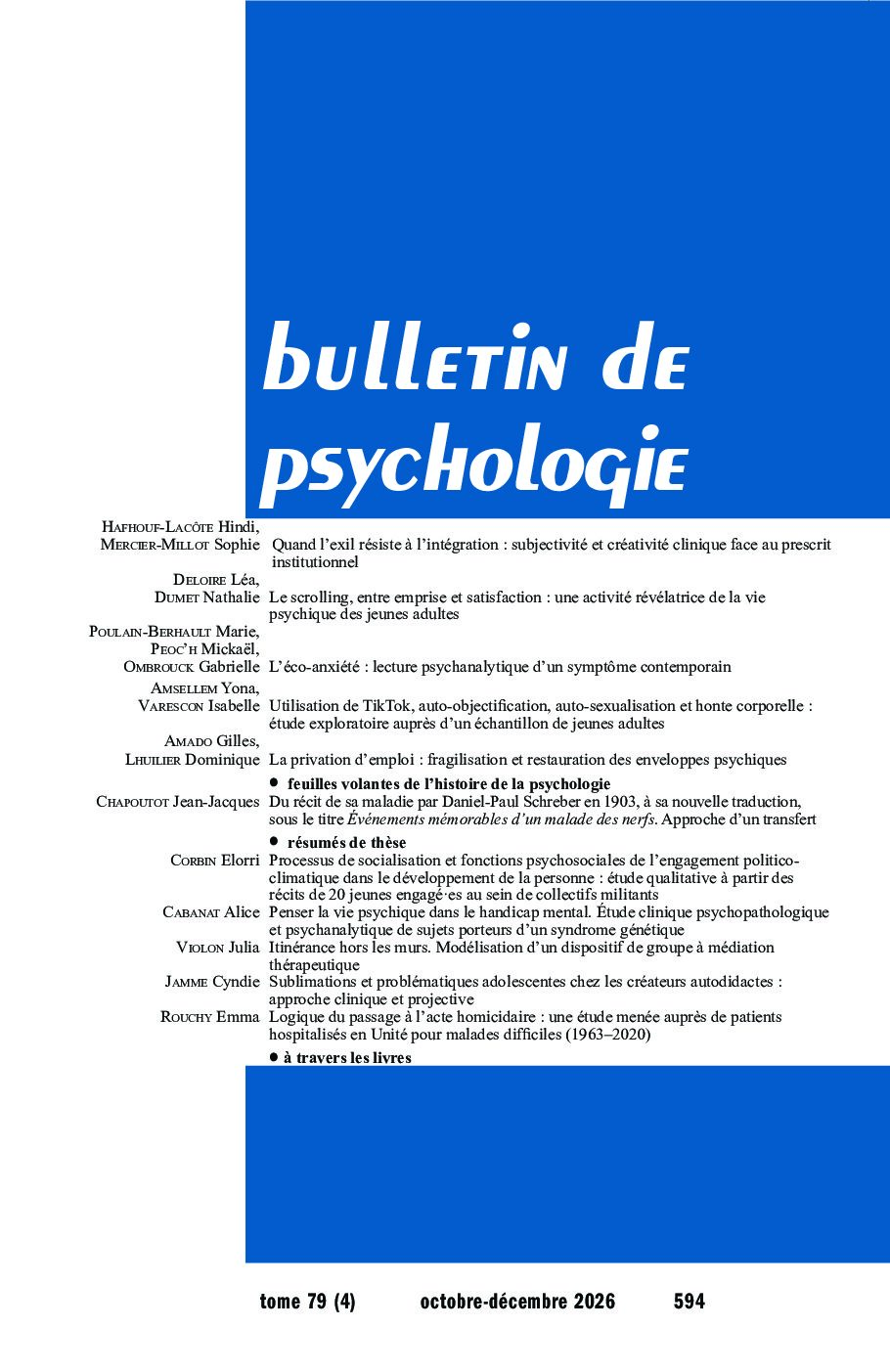
Hafhouf-Lacôte (Hindi), Mercier-Millot (Sophie).— Quand l’exil résiste à l’intégration : subjectivité et créativité clinique face au prescrit institutionnel, Bulletin de psychologie, Tome 79 (4), N°594, 2026, p. 3-10.
Résumé : Cet article interroge l’articulation entre temporalité institutionnelle et temporalité psychique dans les parcours de personnes migrantes et en situation de précarité. À partir d’une démarche ethnographique croisant psychologie clinique, psychologie sociale et psychologie interculturelle, deux situations cliniques sont analysées. Ces récits mettent en évidence la difficulté de métaboliser l’histoire traumatique de l’exil et d’investir un avenir, lorsqu’un décalage s’instaure entre les dispositifs institutionnels, organisés autour de normes d’insertion et d’efficacité, et la temporalité psychique propre aux sujets. La compulsion de répétition, la nostalgie mélancolique et l’impossible élaboration ne traduisent pas obligatoirement un refus d’intégration, mais une tentative de symbolisation entravée.
Title: When exile resists integration: Subjectivity and clinical creativity in the face of institutional prescriptions
Abstract: This article examines the relationship between institutional temporality and psychological temporality in the lives of migrants and people in precarious situations. Using an ethnographic approach that combines clinical psychology, social psychology, and intercultural psychology, two clinical situations are analyzed. These accounts highlight the difficulty of coming to terms with the traumatic history of exile and investing in the future when there is a disconnect between institutional mechanisms, organized around standards of integration and efficiency, and the psychological temporality specific to the subjects. The compulsion to repeat, melancholic nostalgia, and the impossibility of elaboration do not reflect a refusal to integrate, but rather an attempt at symbolization that has been hindered.
Deloire (Léa), Dumet (Nathalie).— Le scrolling, entre emprise et satisfaction : une activité révélatrice de la vie psychique des jeunes adultes, Bulletin de psychologie, Tome 79 (4), N°594, 2026, p. 11-23.
Résumé : Notre recherche s’intéresse aux intérêts et incidences psychiques du scrolling sur les réseaux sociaux, chez une population de jeunes adultes. Elle s’appuie sur deux rencontres organisées autour d’entretiens cliniques de recherche et de tests projectifs. Face à l’image numérique, capable de troubler voire d’influer sur le sujet, celui-ci s’engage dans un jeu d’équilibriste entre emprise reçue et emprise agie, armes de lutte contre une position de vulnérabilité.Cette emprise sur l’autre, qu’il soit virtuel ou actuel, court-circuite l’avènement de l’expérience de satisfaction ainsi que la capacité du sujet à puiser dans son appareil à représentations pour affronter ses vécus. À défaut d’une activité de rêverie et d’un système de préconscient suffisamment efficient, le sujet jeune adulte peine à négocier les réaménagements psychiques auxquels il se trouve confronté.
Title: Scrolling, between grip and satisfaction: A revealing activity in the psychic life of young adults
Abstract: Our research focuses on the psychic interests and implications of scrolling on social networks, in a population of young adults. It is based on two meetings organized around clinical research interviews and projective tests. Faced with the digital image, capable of disturbing or even influencing the subject, the latter engages in a balancing game between the grip received by the subject of the image and the grip exercised by the subject on the image, weapons of struggle against a position of vulnerability. This grip on the other, whether virtual or actual, short-circuits the advent of the experience of satisfaction as well as the ability of the subject to draw from his apparatus representations to face his experiences. In the absence of a sufficiently efficient reverie activity and preconscious system, the young adult subject struggles to negotiate the psychological changes he is confronted with.
Poulain-Berhault (Marie), Peoc’h (Mickaël), Ombrouck (Gabrielle).— L’éco-anxiété : lecture psychanalytique d’un symptôme contemporain, Bulletin de psychologie, Tome 79 (4), N°594, 2026, p. 25-36.
Résumé : Il est aujourd’hui généralement admis que le dérèglement climatique affecte la santé psychique de la population. Chaque continent est touché, à des degrés variables, par des évènements météorologiques disproportionnés. La littérature scientifique décrit des données concernant les états de stress post-traumatique y afférents et les épisodes anxio-dépressifs caractérisés par l’éco-anxiété. Les professionnels de santé peuvent être confrontés, dans leur pratique, à des patients présentant ces émotions et questionnements à ce sujet. Les auteurs proposent une analyse du signifiant contemporain éco-anxiété notamment illustré par trois cas cliniques contemporains. Dans les recherches en sciences humaines, cette notion prend soit une valeur de trouble qui provoque des émotions négatives, soit elle est un moteur pour trouver une façon d’habiter le monde. Nous proposons également de l’aborder sous l’angle du symptôme au sens psychanalytique en ce qu’il fait souffrir et est aussi une solution psychique.
Title: Eco-anxiety: A psychoanalytic interpretation of a contemporary symptom
Abstract: It is now widely acknowledged that climate change has an impact on the mental health of the population. Every continent is affected, to varying degrees, by extreme weather events. The scientific literature reports data concerning related post-traumatic stress states and anxiety-depressive episodes characterized by eco-anxiety. Healthcare professionals may encounter patients experiencing these emotions and concerns in their practice. The authors offer an analysis of the contemporary signifier “eco-anxiety” notably illustrated by three contemporary clinical cases. In humanities research, this concept is either seen as a disorder that triggers negative emotions or as a driving force for finding new ways to inhabit the world. We also propose to approach it from the perspective of the symptom in the psychoanalytic sense—both as a source of suffering and as a psychic solution.
Amsellem (Yona), Varescon (Isabelle).— Utilisation de TikTok, auto-objectification, auto-sexualisation et honte corporelle : étude exploratoire auprès d’un échantillon de jeunes adultes, Bulletin de psychologie, Tome 79 (4), N°594, 2026, p. 37-48.
Résumé : Cette étude exploratoire examine l’utilisation de TikTok chez de jeunes adultes en lien avec la honte corporelle, l’auto-objectification et l’auto-sexualisation (perception de soi objectifiée et sexualisée). Soixante participants (18-25 ans) ont complété en ligne un questionnaire d’utilisation de TikTok, les échelles Bergen d’addiction aux réseaux sociaux (BSMAS) et de satisfaction de la sexualisation (ESS), le questionnaire d’auto-objectification (LSOQ), et une échelle de honte corporelle de l’échelle de conscience corporelle objectifiée (OBCS). Les résultats démontrent une utilisation problématique de TikTok chez 8 participants et des associations significatives entre les scores à la BSMAS et au LSOQ (p< 0,05), l’ESS (p< 0,01), et la honte corporelle (p< 0,05). Cette étude souligne ainsi l’intérêt d’étudier l’impact de l’utilisation de TikTok, à des fins préventives et de recherche.
Title: TikTok use, self-objectification, self-sexualization, and body shame: An exploratory study among a sample of young adults
Abstract: This exploratory study examines the use of TikTok among young adults in relation to body shame, self-objectification, and self-sexualization (objectified and sexualized self-perception). Sixty participants (18–25 years) completed online a questionnaire on TikTok use, the Bergen Social Media Addiction Scale (BSMAS), the Enjoyment of Sexualization Scale (ESS), the Self-Objectification Questionnaire (LSOQ), and a Body Shame subscale from the Objectified Body Consciousness Scale (OBCS). The results demonstrated problematic TikTok use among 8 participants and significant associations between BSMAS scores and those of the LSOQ (p< 0.05), ESS (p< 0.01), and body shame (p< 0.05). These findings highlight the relevance of investigating the impact of TikTok use for both preventive and research purposes.
Amado (Gilles), Lhuilier (Dominique).— La privation d’emploi : fragilisation et restauration des enveloppes psychiques, Bulletin de psychologie, Tome 79 (4), N°594, 2026, p. 49-62.
Résumé : Les liens entre précarité sociale et précarité psychique sont particulièrement manifestes dans les contextes de privation d’emploi. En effet, l’activité constitue un vecteur privilégié des processus de socialisation et de subjectivation. Les enseignements de la recherche-action réalisée auprès de chômeurs permettent de mettre l’accent sur la fragilisation des enveloppes psychiques (individuelles, groupales, professionnelles), mais aussi d’identifier les dynamiques de reconstruction de projets professionnels et de restauration de l’estime de soi. Au cours de cette recherche-action, ont été expérimentés avec succès des dispositifs d’accompagnement qui privilégient les savoirs expérientiels et les ressources des collectifs de pairs.
Title: Joblessness: Weakening and restoration of psychic envelopes
Abstract: The links between social precarity and psychological precarity are particularly obvious in situations of joblessness. Activity is a key vehicle for socialization and subjectivation. The lessons learned from the action-research carried out with unemployed people highlight the weakening of psychic envelopes (individual, group, professional), but they also identify the dynamics of rebuilding professional projects and restoring self-esteem. In the course of this action-research project, we successfully tested support systems that focus on experiential knowledge and the resources of peer groups.
• Feuilles volantes de l’histoire de la psychologie
Chapoutot (Jean-Jacques).— Du récit de sa maladie par Daniel-Paul Schreber en 1903, à sa nouvelle traduction, sous le titre Événements mémorables d’un malade des nerfs. Approche d’un transfert, Bulletin de psychologie, Tome 79 (4), N°594, 2026, p. 63-74.
Résumé : En 1903, Daniel Paul Schreber publiait le récit de sa propre démence, pour obtenir sa libération de l’asile où il était interné, et en même temps pour donner à la science les preuves de la véracité de son délire d’engendrement d’une nouvelle humanité, au moyen de sa transformation en femme de Dieu. À partir de ce récit, Freud, dans un texte célèbre, a mis en place la psychose comme objet de la psychanalyse, suivi en 1956 par Lacan, qui a théorisé le concept de forclusion du Nom du Père. Une première traduction en français de ce récit a été publiée en 1975 sous le titre Mémoires d’un névropathe. En octobre 2025 paraît une nouvelle traduction en français sous le titre Événements mémorables d’un malade des nerfs. Le présent article analyse le cheminement des traducteurs, leurs difficultés, la nouveauté de leur démarche, pour montrer les apports (et quelques limites) de ce qui constitue un véritable événement dans le monde de la psychanalyse, de la psychiatrie, et plus largement des sciences humaines.
Title: From the account of his illness by Daniel-Paul Schreber in 1903, to its new translation entitled Memorable events in the life of a nervous patient. Approach of a transference
Abstract: In 1903, Daniel Paul Schreber published his account of his own dementia, in order to obtain his release from the asylum where he was interned and at the same time to provide science with proof of the truth of his delusion that he was creating a new humanity by transforming himself into the wife of God. Based on this story, Freud famously established psychosis as the object of psychoanalysis, followed by Lacan in 1956, who theorised the concept of the forclusion of the Name of the Father. A first French translation of this account was published in 1975 under the title Mémoires d’un névropathe (Memoirs of a Neuropath). In October 2025, a new French translation is published under the title Événements mémorables d›un malade des nerfs (Memorable Events of a Nervous Patient). This article analyses the translators’ approach, their difficulties and the novelty of their method, in order to highlight the contributions (and some limitations) of what can be considered as a truly significant event in the world of psychoanalysis, psychiatry and, more broadly, the humanities.
• résumés de thèse
Corbin (Elorri).— Processus de socialisation et fonctions psychosociales de l’engagement politico-climatique dans le développement de la personne : étude qualitative à partir des récits de 20 jeunes engagé·es au sein de collectifs militants, Bulletin de psychologie, Tome 79 (4), N°594, 2026, p. 75-78.
Title: Socialization processes and psychosocial functions of climate-political activism in individual development: Qualitative study based on the narratives of 20 young people involved in grassroots collectives
Cabanat (Alice).— Penser la vie psychique dans le handicap mental. Étude clinique psychopathologique et psychanalytique de sujets porteurs d’un syndrome génétique, Bulletin de psychologie, Tome 79 (4), N°594, 2026, p. 79-82.
Title: Thinking about psychic life in intellectual disability: Clinical psychopathological and psychoanalytic study of subjects with a genetic syndrome
Violon (Julia).— Itinérance hors les murs. Modélisation d’un dispositif de groupe à médiation thérapeutique, Bulletin de psychologie, Tome 79 (4), N°594, 2026, p. 83-86.
Title: Strolling beyond the walls. Modeling a Therapeutic Mediation Group Setting
Jamme (Cyndie).— Sublimations et problématiques adolescentes chez les créateurs autodidactes : approche clinique et projective, Bulletin de psychologie, Tome 79 (4), N°594, 2026, p. 87-90.
Title: Sublimation and adolescent issues among self-taught creators: A clinical and projective approach
Rouchy (Emma).— Logique du passage à l’acte homicidaire : une étude menée auprès de patients hospitalisés en Unité pour malades difficiles (1963–2020), Bulletin de psychologie, Tome 79 (4), N°594, 2026, p. 91-94.
Title: The Logic of Homicidal Acts: A Study Conducted Among Patients Hospitalized in a French Secure Forensic Psychiatric Unit (1963 to 2020)
• à travers les livres